


Page 49 - CII-ARTHA
P. 49
MARCH 2026


           Similarly, India exhibits relatively high unemployment at   delayed entry into the labour market, as a significant
           advanced education levels for men as well. This       share of individuals at this stage opt to pursue higher
           pattern presents a paradox: while men and women       education rather than immediate employment.
           with basic and intermediate education appear to find
           employment more easily, those with higher
           qualifications face greater barriers - possibly due to   Demand-side and Supply-side
           skill-job mismatches, limited creation of high-skill   Challenges to Female Labour
           positions, or saturation in formal sectors. While     Force Participation
           labour-intensive sectors may absorb less-educated
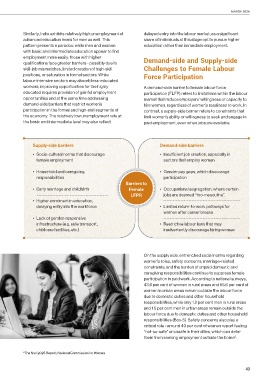
           workers, improving opportunities for the highly       A demand-side barrier to female labour force
           educated requires provision of gainful employment     participation (FLFP) refers to limitations within the labour
           opportunities and at the same time addressing         market that reduce employers’ willingness or capacity to
           demand-side barriers that restrict women’s            hire women, regardless of women’s readiness to work. In
           participation in the formal and high-skill segments of   contrast, a supply-side barrier refers to constraints that
           the economy. The relatively low unemployment rate at   limit women’s ability or willingness to seek and engage in
           the basic and intermediate level may also reflect      paid employment, even when jobs are available.


                Supply-side barriers                                    Demand-side barriers
                •   Socio-cultural norms that discourage                •   Insufficient job creation, especially in
                 female employment                                        sectors that employ women

                •   Household and caregiving                            •   Gender pay gaps, which discourage
                 responsibilities                                         participation
                                                         Barriers to
                •   Early marriage and childbirth         Female        •   Occupational segregation, where certain
                                                           LFPR           jobs are deemed “too-masculine”.
                •   Higher enrolment in education,
                 delaying entry into the workforce                      •   Limited return-to-work pathways for
                                                                          women after career breaks
                •   Lack of gender-responsive
                 infrastructure (e.g. safe transport,                   •   Restrictive labour laws that may
                 childcare facilities, etc.)                              inadvertently discourage hiring women


                                                                 On the supply side, entrenched social norms regarding
                                                                 women’s roles, safety concerns, marriage-related
                                                                 constraints, and the burden of unpaid domestic and
                                                                 caregiving responsibilities continue to suppress female
                                                                 participation in paid work. According to national surveys,
                                                                 43.6 per cent of women in rural areas and 55.6 per cent of
                                                                 women in urban areas remain outside the labour force
                                                                 due to domestic duties and other household
                                                                 responsibilities, while only 1.2 per cent men in rural areas
                                                                 and 1.5 per cent men in urban areas remain outside the
                                                                 labour force due to domestic duties and other household
                                                                 responsibilities (Box-5). Safety concerns also play a
                                                                 critical role - around 40 per cent of women report feeling
                                                                 “not-so-safe” or unsafe in their cities, which can deter
                                                                 them from seeking employment outside the home .
                                                                                                         5

           5 The Nari 2025 Report; National Commission for Women


                                                                                                              49

