


Page 23 - CII ARTHA
P. 23
OCTOBER 2025


         Regional Distribution of                               together host more than 45.0 per cent of India’s factories and
         Manufacturing                                          workers, and a similar share of output and value added,
                                                                underscoring their role as industrial hubs.

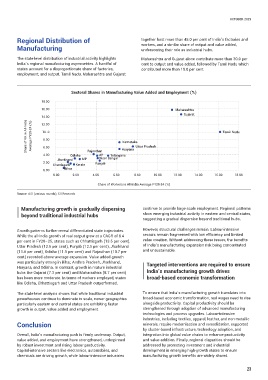
         The state-level distribution of industrial activity highlights   Maharashtra and Gujarat alone contribute more than 30.0 per
         India’s regional manufacturing asymmetries. A handful of   cent to output and value added, followed by Tamil Nadu which
         states account for a disproportionate share of factories,   contributed more than 10.0 per cent.
         employment, and output. Tamil Nadu, Maharashtra and Gujarat


                                 Sectoral Shares in Manufacturing Value Added and Employment (%)

                   18.00
                   16.00                                                       Maharashtra
                                                                                   Gujarat
                   14.00
             Share of VA in All-India   Average FY20-24 (%)  10..0  Karnataka                       Tamil Nadu
                   12.00


                    8.00
                    6.00
                                                       Haryana
                    4.00        Odisha  Rajasthan  Telangana  Uttar Pradesh
                                             AP
                          Jharkhand  MP      West Bengal
                    2.00                   Punjab
                         Chattisgarh  Kerala
                    0.00      Bihar
                         0.00    2.00     4.00     6.00      8.00    10.00    12.00    14.00    16.00    18.00
                                            Share of Workers in All-India Average FY20-24 (%)

         Source: ASI (various rounds), CII Research


          Manufacturing growth is gradually dispersing          continue to provide large-scale employment. Regional patterns
          beyond traditional industrial hubs                    show emerging industrial activity in eastern and central states,
                                                                suggesting a gradual dispersion beyond traditional hubs.

         Growth patterns further reveal differentiated state trajectories.   However, structural challenges remain. Labour-intensive
         While the all-India growth of real output grew at a CAGR of 8.4   sectors remain fragmented with low efficiency and limited
         per cent in FY20–25, states such as Chhattisgarh (13.5 per cent),   value creation. Without addressing these issues, the benefits
         Uttar Pradesh (12.6 per cent), Punjab (12.5 per cent), Jharkhand   of India’s manufacturing expansion risk being concentrated
         (11.6 per cent), Odisha (11.5 per cent) and Rajasthan (10.7 per   and unsustainable.
         cent) recorded above-average expansion. Value added growth
         was particularly strong in Bihar, Andhra Pradesh, Jharkhand,   Targeted interventions are required to ensure
         Haryana, and Odisha. In contrast, growth in mature industrial
         hubs like Gujarat (7.3 per cent) and Maharashtra (8.7 per cent)   India’s manufacturing growth drives
         has been more moderate. In terms of workers employed, states   broad-based economic transformation
         like Odisha, Chhattisgarh and Uttar Pradesh outperformed.
         The state-level analysis shows that while traditional industrial   To ensure that India’s manufacturing growth translates into
         powerhouses continue to dominate in scale, newer geographies   broad-based economic transformation, real wages need to rise
         particularly eastern and central states are exhibiting faster   alongside productivity. Capital productivity should be
         growth in output, value added and employment.          strengthened through adoption of advanced manufacturing
                                                                technologies and process upgrades. Labour-intensive
                                                                industries, including textiles, apparel, leather, and non-metallic
         Conclusion                                             minerals, require modernisation and consolidation, supported
                                                                by cluster-based infrastructure, technology adoption, and
         Overall, India’s manufacturing push is firmly underway. Output,   integration into global value chains to enhance productivity
         value added, and employment have strengthened, underpinned   and value addition. Finally, regional disparities should be
         by robust investment and rising labour productivity.   addressed by promoting investment and industrial
         Capital-intensive sectors like electronics, automobiles, and   development in emerging high-growth states to ensure
         chemicals are driving growth, while labour-intensive industries   manufacturing growth benefits are widely shared.

                                                                                                               23

